> ## Documentation Index
> Fetch the complete documentation index at: https://prismeai-legacy.mintlify.site/llms.txt
> Use this file to discover all available pages before exploring further.

# Agent Types

> Explore the different types of AI agents you can create with Prisme.ai

Prisme.ai supports multiple agent architectures, each optimized for different use cases, capabilities, and complexity levels. Understanding the strengths and applications of each agent type will help you select the right approach for your specific business needs.

## Agent Type Comparison

<table>
  <thead>
    <tr>
      <th>Agent Type</th>
      <th>Key Capabilities</th>
      <th>Best For</th>
      <th>Technical Complexity</th>
    </tr>
  </thead>

  <tbody>
    <tr>
      <td>Simple Prompting</td>

      <td>
        * Custom instructions<br />
        * Persona definition<br />
        * Response formatting
      </td>

      <td>
        * Basic Q\&A<br />
        * Standardized responses<br />
        * Content generation
      </td>

      <td>Low</td>
    </tr>

    <tr>
      <td>RAG Agents</td>

      <td>
        * Knowledge retrieval<br />
        * Document grounding<br />
        * Contextual responses
      </td>

      <td>
        * Knowledge-intensive applications<br />
        * Document-based workflows<br />
        * Internal expertise access
      </td>

      <td>Medium</td>
    </tr>

    <tr>
      <td>Tool-Using Agents</td>

      <td>
        * API integration<br />
        * Tool selection<br />
        * Multi-step tasks
      </td>

      <td>
        * System integration<br />
        * Data processing<br />
        * External service access
      </td>

      <td>Medium-High</td>
    </tr>

    <tr>
      <td>Multi-Agent Systems</td>

      <td>
        * Agent collaboration<br />
        * Task distribution<br />
        * Complex workflows
      </td>

      <td>
        * Advanced business processes<br />
        * Cross-functional workflows<br />
        * Complex problem solving
      </td>

      <td>High</td>
    </tr>
  </tbody>
</table>

## Simple Prompting Agents

Simple prompting agents leverage the capabilities of foundation models with specialized instructions, personas, and response formats. While they are the most straightforward to implement, they can still be powerful tools for many business applications.

### Key Features

* **Custom Instructions**: Detailed guidance for the agent's behavior and responses
* **Context Management**: Control over how the agent maintains conversation history
* **Response Formatting**: Structured outputs for consistent user experiences
* **Persona Definition**: Tailored voice, tone, and communication style

### Use Cases

<CardGroup cols={2}>
  <Card title="Customer Support" icon="headset">
    Agents that provide consistent answers to common customer inquiries
  </Card>

  <Card title="Content Creation" icon="pen-nib">
    Assistants that help generate marketing copy, emails, or reports
  </Card>

  <Card title="Training & Onboarding" icon="graduation-cap">
    Agents that help new employees learn company processes and policies
  </Card>

  <Card title="Information Access" icon="circle-info">
    Assistants that provide quick access to frequently needed information
  </Card>
</CardGroup>

[Learn more about Simple Prompting Agents →](/create-agents/no-code/simple-prompting-agent)

## RAG Agents

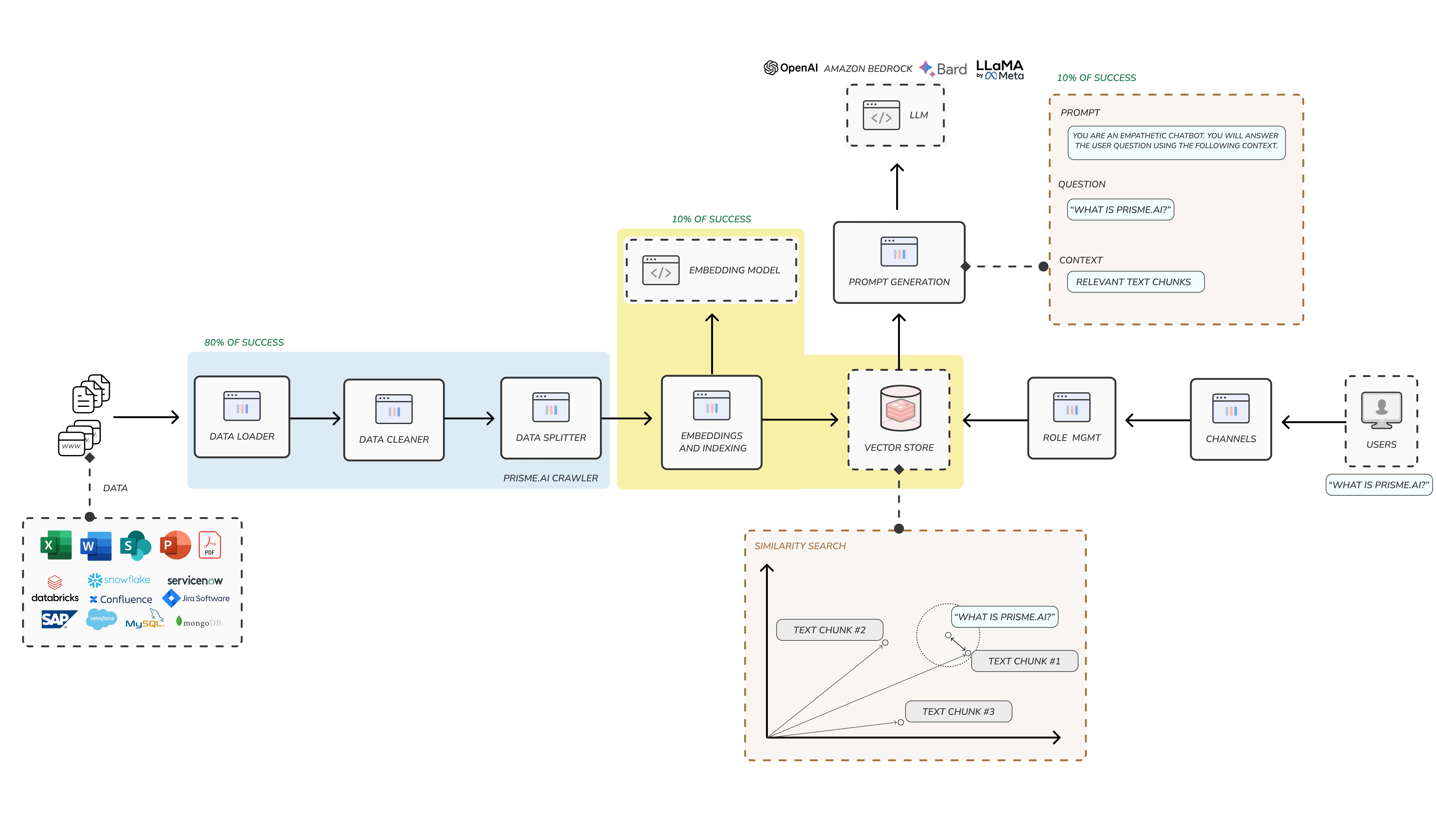
RAG (Retrieval Augmented Generation) agents connect foundation models to your organization's specific knowledge and information. These agents can access, search, and incorporate proprietary information into their responses.

<Frame>
  <img src="https://mintcdn.com/prismeai-legacy/jdOgS9ouJy0zTcFo/images/rag-architecture.png?fit=max&auto=format&n=jdOgS9ouJy0zTcFo&q=85&s=e9b152ea7261977aa3f429fb93794de9" alt="RAG Agent Architecture" width="9220" height="5396" data-path="images/rag-architecture.png" />
</Frame>

### Key Features

* **Knowledge Base Integration**: Connection to document repositories and knowledge bases
* **Contextual Retrieval**: Intelligent selection of relevant information
* **Source Attribution**: Traceability to source documents
* **Factual Grounding**: Responses anchored in verified organizational knowledge

### Use Cases

<CardGroup cols={2}>
  <Card title="Technical Documentation" icon="file-code">
    Agents that help users navigate complex technical information
  </Card>

  <Card title="Policy Guidance" icon="scale-balanced">
    Assistants that provide accurate information about company policies
  </Card>

  <Card title="Product Knowledge" icon="box">
    Agents that share detailed product specifications and capabilities
  </Card>

  <Card title="Research Assistance" icon="microscope">
    Assistants that help analyze and extract insights from research collections
  </Card>
</CardGroup>

[Learn more about RAG Agents →](/create-agents/no-code/rag-agent)

## Tool-Using Agents

Tool-using agents extend beyond conversation to take actions on behalf of users. These agents can integrate with APIs, access external services, and execute complex tasks across multiple systems.

### Key Features

* **Tool Integration**: Connection to internal and external APIs and services
* **Tool Selection**: Intelligent determination of which tools to use for a task
* **Multi-Step Execution**: Capability to perform complex sequences of actions
* **Error Handling**: Graceful management of failures and unexpected results

### Use Cases

<CardGroup cols={2}>
  <Card title="Data Processing" icon="database">
    Agents that can retrieve, analyze, and visualize business data
  </Card>

  <Card title="System Integration" icon="plug">
    Assistants that connect to CRM, ERP, or other enterprise systems
  </Card>

  <Card title="Workflow Automation" icon="robot">
    Agents that execute multi-step business processes across systems
  </Card>

  <Card title="Resource Management" icon="calendar">
    Assistants that help schedule, book, or allocate resources
  </Card>
</CardGroup>

[Learn more about Tool-Using Agents →](/create-agents/tool-agents/overview)

## Multi-Agent Systems

Multi-agent systems combine specialized agents into collaborative networks that can handle complex workflows and business processes. These systems distribute tasks, share information, and collectively solve problems beyond the capabilities of individual agents.

### Key Features

* **Specialized Agents**: Division of responsibilities among purpose-built agents
* **Collaboration Protocols**: Structured communication between agents
* **Task Distribution**: Intelligent allocation of work across the system
* **Orchestration**: Coordination of multi-agent workflows and processes

### Use Cases

<CardGroup cols={2}>
  <Card title="Complex Problem Solving" icon="puzzle-piece">
    Systems that break down and solve multi-faceted business problems
  </Card>

  <Card title="Cross-Functional Workflows" icon="diagram-project">
    Agent networks that span departmental boundaries and systems
  </Card>

  <Card title="Specialized Expertise" icon="users-gear">
    Collaborative systems that combine different domain experts
  </Card>

  <Card title="Adaptive Processes" icon="arrows-rotate">
    Multi-agent workflows that adapt to changing conditions and requirements
  </Card>
</CardGroup>

[Learn more about Multi-Agent Systems →](/create-agents/tool-agents/overview)

## Selecting the Right Agent Type

When determining which agent architecture to use, consider these factors:

<Accordion title="Task Complexity">
  **Simple tasks** can often be handled by simple prompting agents, while **complex workflows** involving multiple systems may require tool-using agents or multi-agent systems.

  Ask yourself:

  * How many steps are involved in the process?
  * Does the task require access to multiple systems?
  * Is significant decision-making required?
</Accordion>

<Accordion title="Knowledge Requirements">
  If your agent needs to access **organizational knowledge** (documents, policies, procedures), a RAG agent is likely the best choice.

  Consider:

  * Does the agent need to reference internal documents?
  * Is the information frequently updated?
  * Is factual accuracy and attribution important?
</Accordion>

<Accordion title="Integration Needs">
  For agents that need to **interact with other systems** (databases, APIs, services), tool-using agents provide the necessary capabilities.

  Evaluate:

  * Does the agent need to access external data?
  * Will it need to take actions in other systems?
  * Are there APIs available for the required integrations?
</Accordion>

<Accordion title="Technical Resources">
  More complex agent types require greater technical expertise to implement and maintain.

  Consider your team's:

  * Experience with AI systems
  * Development resources
  * Operational support capabilities
</Accordion>

<Accordion title="Scalability Requirements">
  For enterprise-wide deployment, consider how the agent architecture will scale.

  Think about:

  * Number of potential users
  * Performance requirements
  * Infrastructure considerations
</Accordion>

## Hybrid Approaches

Many effective enterprise agents combine elements from multiple agent types. For example:

* A RAG agent with tool-using capabilities
* A multi-agent system where some agents use RAG
* Simple prompting agents that can escalate to more complex agent types when needed

Prisme.ai's platform supports these hybrid approaches, allowing you to build the optimal solution for your specific requirements.

## Next Steps

Ready to start building? Choose an agent type to learn more:

<CardGroup cols={2}>
  <Card title="Simple Prompting" icon="message" href="/create-agents/no-code/simple-prompting-agent">
    Get started with basic agents powered by specialized instructions
  </Card>

  <Card title="RAG Agents" icon="database" href="/create-agents/no-code/rag-agent">
    Create agents that leverage your organization's knowledge
  </Card>

  <Card title="Tool-Using Agents" icon="screwdriver-wrench" href="/create-agents/no-code/rag-builtin-tools-agent">
    Build agents that can use tools to perform complex tasks
  </Card>

  <Card title="Multi-Agent Systems" icon="users" href="/create-agents/tool-agents/overview">
    Develop collaborative systems with multiple specialized agents
  </Card>
</CardGroup>